Big Four Audit Interview Questions (2026): 25 Questions With Model Answers
The 25 questions Big Four audit interviewers ask most, from "why audit?" to materiality and going concern, with what each tests and a model answer.
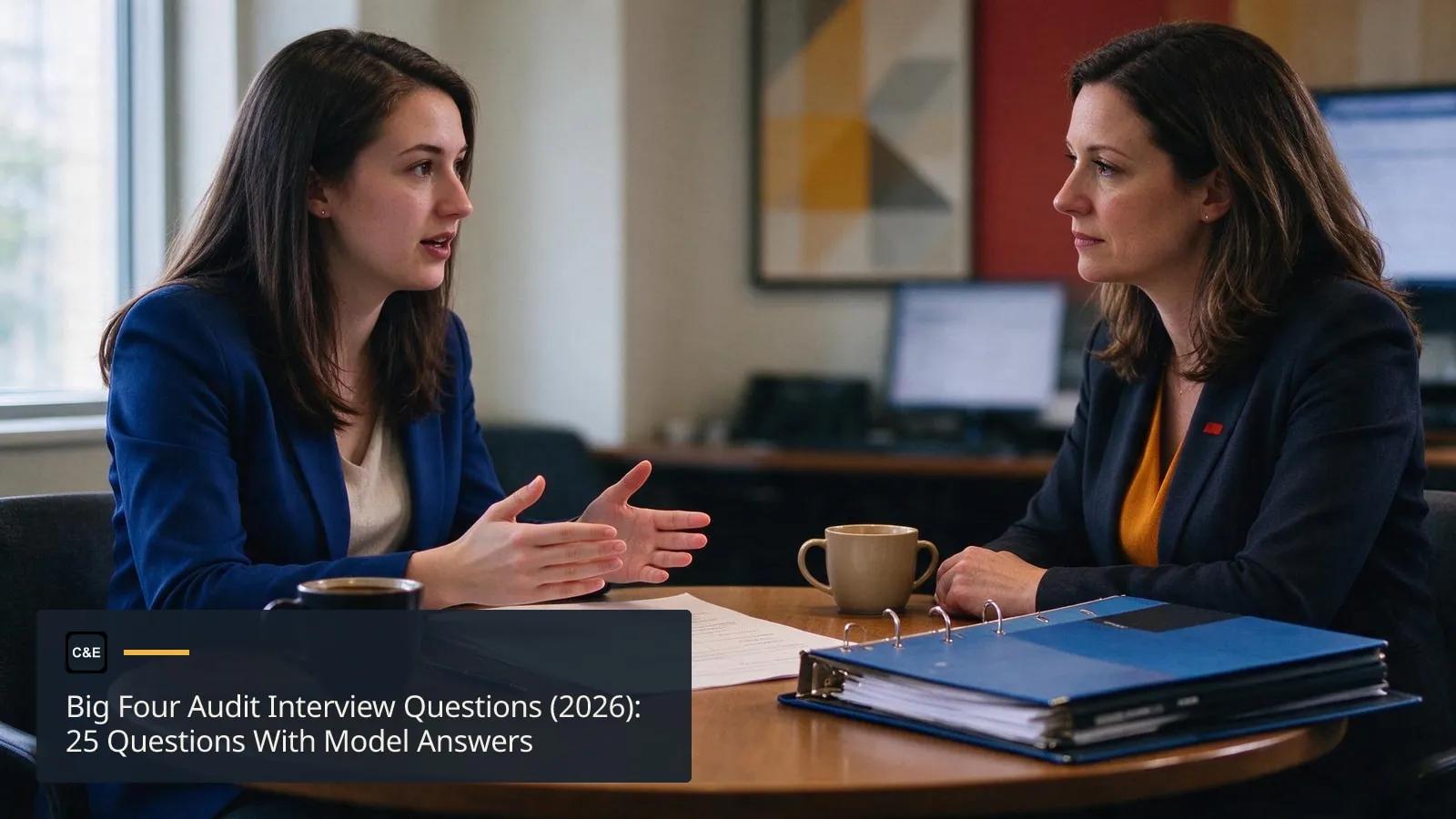
Big Four audit interview questions fall into four groups: why audit and why this firm, competency questions about how you work, basic audit technicals (materiality, scepticism, risk, evidence), and commercial awareness. Graduate interviews put most weight on motivation and competencies. Lateral and senior interviews add technical depth and judgement. Below are 25 questions we see come up across the UK, Ireland and the US, each with what the interviewer is testing and a model answer we wrote.
The model answers are examples, not scripts. Swap in your own facts: interviewers ask follow-ups, and a borrowed story falls apart by the second "why?".
Key takeaways
- Big Four audit interviews test motivation, competencies, basic audit technicals and commercial awareness, with technical depth rising for experienced hires.
- KPMG UK's published graduate process has four stages, including a timed cognitive test, a six-question video interview and a half-day assessment event.
- Strong technical answers explain materiality, professional scepticism, the audit risk model and assertions in plain English, with a client example.
- The FRC's revised fraud and going concern standards apply to audits of periods beginning on or after 15 December 2026, which makes a good current-affairs answer.
- Build every competency answer from your own CV, because interviewers keep asking follow-up questions until a borrowed story breaks.
How Big Four audit interviews run in 2026
Most graduate routes now front-load online assessments before you speak to anyone. KPMG UK publishes its graduate process in four stages: an application form with a job preview quiz, a skills assessment plus a 36-minute timed cognitive assessment, a video interview of 6 pre-recorded questions, and an in-person half-day assessment event it calls Launch Pad. The other firms use the same building blocks in a different order, so check the current page for the firm and country you're applying to.
What that means for preparation:
- Video interview: short, timed answers to motivation and competency questions. You can't read the interviewer, so structure matters more than charm.
- Assessment day or final interview: a mix of group work, a case or written exercise, and a one-to-one or panel interview with a manager, director or partner.
- Experienced hires (associate, senior, assistant manager): usually two interviews, one competency-led and one technical, often with a walk-through of an audit you worked on.
Motivation questions: why audit, why this firm
1. Why audit? What it tests: whether you know what the job is day to day, not just that it leads to a qualification. Model answer: "I want a role where I learn how lots of different businesses actually make and lose money, quickly. Audit does that: in the first two years I'd see several clients' revenue, cost and control processes up close. I also like work with a right answer you have to evidence. And the ACA training contract gives me structure while I learn."
2. Why our firm rather than the other three? What it tests: research and genuine choice. "Your reputation" scores nothing. Model answer: "Two reasons. I spoke to [name, role] at [event] about the [office or sector] audit team, and the client mix there matches my interest in [sector]. And your [specific programme, technology or training route] means I'd [concrete benefit]." Name something you could only say about this firm.
3. Why audit over tax or advisory? What it tests: that you've compared options and won't transfer in six months. Model answer: "Tax goes deep on one area of law. I want breadth first: understanding the whole set of financial statements and the business behind them. Advisory work often builds on that grounding anyway, so audit is the better foundation for me."
4. What do you think a first-year auditor does? What it tests: realistic expectations. Model answer: "Mostly fieldwork on lower-risk areas: vouching samples to invoices and contracts, bank and cash testing, chasing client requests, and documenting work so a senior can review it. Busy season is long hours around year ends. The skill is being accurate and organised while juggling several clients."
5. Which qualification will you study, and how will you manage exams alongside work? What it tests: commitment to the training contract (ACA or ACCA in the UK and Ireland, the CPA in the US). Model answer: "I've looked at the exam structure and plan to treat study like a fixed client deadline: blocked evenings, the college days the firm provides, and revision planned around busy season. At university I [real example of managing exams alongside a job or society]." Our ACCA vs CIMA vs ACA comparison sets out the differences if you need to explain your choice.
Competency questions: how you work
Use a short STAR structure for these (situation, task, action, result), and put most of your words into the action. There are worked examples in our guide to STAR interview examples for finance.
6. Tell me about a time you worked to a tight deadline. What it tests: prioritisation and communication under pressure, the reality of busy season. Model answer (structure): "In [situation], three pieces of work landed in the same week. I listed what each person needed and by when, agreed with [the team lead] which could move, and told everyone early. I delivered [result], and since then I [habit you kept]."
7. Describe a mistake you made and what you did. What it tests: honesty and whether you escalate. Auditors who hide errors are a risk to the firm. Model answer (structure): "I [specific error]. I spotted it when [how], told [person] the same day, fixed it, and checked whether it had affected anything else. Now I [control you added]." Pick a real, moderate mistake with a fix you can show.
8. Tell me about a time you challenged someone. What it tests: the early form of professional scepticism. Juniors have to query client staff who are more senior than them. Model answer (structure): "A [teammate or manager] wanted to [action]. I thought [reason] because of [evidence]. I asked a question rather than stating a conclusion, showed them the evidence, and we agreed to [outcome]."
9. Give an example of when your attention to detail mattered. What it tests: accuracy, which is the job. Model answer (structure): name what you checked, what didn't reconcile, and what difference it made. A spreadsheet total that didn't match the source data is a perfectly good example.
10. Tell me about a time you dealt with someone difficult. What it tests: client handling. Client staff are busy and don't always want auditors there. Model answer (structure): "[Person] kept missing [deadline]. I asked what was getting in the way, found [cause], and agreed a smaller first deliverable. We got [result]."
11. When have you had to learn something quickly? What it tests: how you'll cope with a new client and a new sector every few weeks. Model answer (structure): what you had to learn, how (sources, people, practice), how fast, and how you knew you'd got it right.
12. Describe a time you faced an ethical dilemma. What it tests: integrity and independence. These underpin every audit opinion. Model answer (structure): "I was asked to [questionable request]. I didn't do it, explained why to [person], and raised it with [appropriate person]." Keep it real and small; don't invent a dramatic story.
Audit technical questions
Graduates get the basics; seniors get the same questions with "how did you apply that on your last job?" attached.
13. What is the purpose of an external audit? What it tests: that you know who the audit is for. Model answer: "To give the shareholders an independent opinion on whether the financial statements give a true and fair view and comply with the applicable framework. Auditors give reasonable assurance, not absolute assurance, and the opinion is addressed to the shareholders, not management."
14. What is materiality? What it tests: the most-used concept in audit. Model answer: "A misstatement is material if it could reasonably be expected to influence the economic decisions of users of the financial statements. The auditor sets an overall materiality, usually as a percentage of a benchmark such as profit before tax or revenue, then a lower performance materiality to allow for errors that go undetected or add up." In the UK the standard is ISA (UK) 320; the FRC's current edition was updated in September 2025.
15. What is professional scepticism? What it tests: mindset. Model answer: "A questioning mind: being alert to evidence that contradicts what management tells you, and not accepting a convenient explanation without support. For example, if a large sale lands two days before year end, you check delivery and whether it was reversed after the year end."
16. Explain the audit risk model. What it tests: how auditors decide how much work to do. Model answer: "Audit risk is the risk of giving the wrong opinion. It depends on the risk of material misstatement (inherent risk and control risk, which sit with the client) and detection risk (the risk our procedures miss something). Where the risk of misstatement is high, we lower detection risk by doing more, or more targeted, substantive work."
17. What's the difference between tests of controls and substantive procedures? What it tests: audit approach. Model answer: "Tests of controls check whether a control worked throughout the period, such as approval of purchase orders. Substantive procedures test the numbers directly, through analytical review or tests of detail. If controls are reliable, we can reduce substantive testing; we always do some substantive work on material balances."
18. How would you test revenue? What it tests: applying assertions to the riskiest balance. Model answer: "Start with the presumed fraud risk in revenue recognition and where it sits for this client. Then: analytical review against prior year and budget, tests of detail from invoices to delivery evidence and cash received (occurrence), from dispatch records to invoices (completeness), and cut-off testing either side of the year end."
19. What are financial statement assertions? Give two examples. What it tests: the language of audit evidence. Model answer: "The claims management makes in the accounts. Existence: the asset is real, tested by inspection or confirmation. Completeness: everything that should be recorded is, tested by working from source documents into the ledger. The direction of the test matters: existence runs from the ledger out, completeness from the evidence in."
20. What would make you worry about going concern? What it tests: judgement and awareness of the reporting consequences. Model answer: "Net current liabilities, losses, a loan due for renewal or covenants close to being breached, the loss of a key customer, or a forecast that relies on funding not yet agreed. I'd review management's cash flow forecast, test its assumptions, check the facility terms, and consider whether disclosure, or a material uncertainty paragraph in the report, is needed."
Commercial awareness and current affairs
21. What's changing in audit right now? What it tests: whether you follow the profession. Model answer: "One example: the FRC published revised UK standards on fraud (ISA (UK) 240) and going concern (ISA (UK) 570) on 30 April 2026. They apply to audits of periods beginning on or after 15 December 2026 and line UK requirements up with the international changes. For a first-year, that means more documented work on fraud risk and on management's going concern assessment." In Ireland or the US, name your own regulator (IAASA or the PCAOB) and a recent development you've read about.
22. Pick a client of ours in the news. What audit risks would you expect? What it tests: linking business news to the accounts. Model answer (structure): name the company, the event (a profit warning, an acquisition, refinancing), and the balance it affects: goodwill impairment, inventory valuation, revenue cut-off or going concern. One company, one event, two risks is plenty.
23. How is technology changing audit? What it tests: realism, not buzzwords. Model answer: "Data analytics lets teams test whole populations of journals or transactions rather than samples, and flag unusual items for follow-up. The judgement still sits with people: deciding what's unusual, why, and what evidence settles it. I'd expect to spend less time ticking and more time explaining exceptions."
Closing questions
24. Do you have any questions for us? What it tests: curiosity and preparation. Model answer: ask one question about the work and one about development, such as "What does a good first busy season look like on this team?" or "How do first-years get sector experience here?" Don't ask anything the careers page answers.
25. Is there anything else you'd like to tell us? What it tests: a last chance to fill a gap. Model answer: "Yes, briefly: I didn't get to mention [relevant experience], which is where I [skill they asked about]." If there's nothing, a one-line thank you and a restatement of why you want the role is fine.
How to prepare in the week before
- Write one STAR story per competency (deadline, mistake, challenge, teamwork, ethics) from your own CV. Use finance CV achievement examples to sharpen the result line of each.
- Learn the technical basics until you can explain them in plain English: materiality, scepticism, audit risk, assertions, going concern.
- Prepare a firm-specific answer to question 2, with a name or a fact only that firm would recognise.
- Rehearse out loud, timed. Video interviews punish rambling. You can practise against a real job advert in our interview practice tool, which asks one technical, two competency and one motivation question and rates each answer.
If you're applying as an experienced hire, look at how we lay out an audit senior CV example. Every line on your CV is a question the partner can ask, so prepare a two-minute walk-through of each engagement on it.
Frequently asked questions
What questions are asked in a Big Four audit interview?
Expect four groups: motivation (why audit, why this firm, why not tax), competency questions answered with STAR examples, basic audit technicals such as materiality, scepticism, audit risk and assertions, and commercial awareness about a client or a recent change in audit. Graduate interviews focus on the first two; experienced hires get more technical questions and a walk-through of their own engagements.
How do I answer "why audit?" in an interview?
Give two or three specific reasons tied to the actual job: seeing how many different businesses work, evidence-based work with a right answer, and structured training towards the ACA, ACCA or CPA. Then add one real example from your studies or work that shows the interest. Avoid generic lines about prestige or the firm's reputation, which every candidate uses.
Do Big Four audit interviews include technical questions for graduates?
Usually only basic ones. Graduates are commonly asked what an audit is for, what materiality means or how they would test a balance like revenue. Interviewers want clear reasoning in plain English rather than exam knowledge. Experienced hires get the same topics in more depth, with follow-ups on how they applied them on real engagements.
How long does the Big Four application process take?
It depends on the firm and intake. KPMG UK, for example, publishes a four-stage graduate process: an application with a job preview quiz, two online assessments, a six-question video interview and an in-person half-day event, with offers made within two working days of that event. Check the current page for your firm and country.