Competency Interview Questions for Accountants: 15 Questions With Example Answers
A question bank for qualified and part-qualified accountants: 15 competency questions grouped by what they assess, mapped to the ICAEW ethics principles, with example answers and a plan for your own.
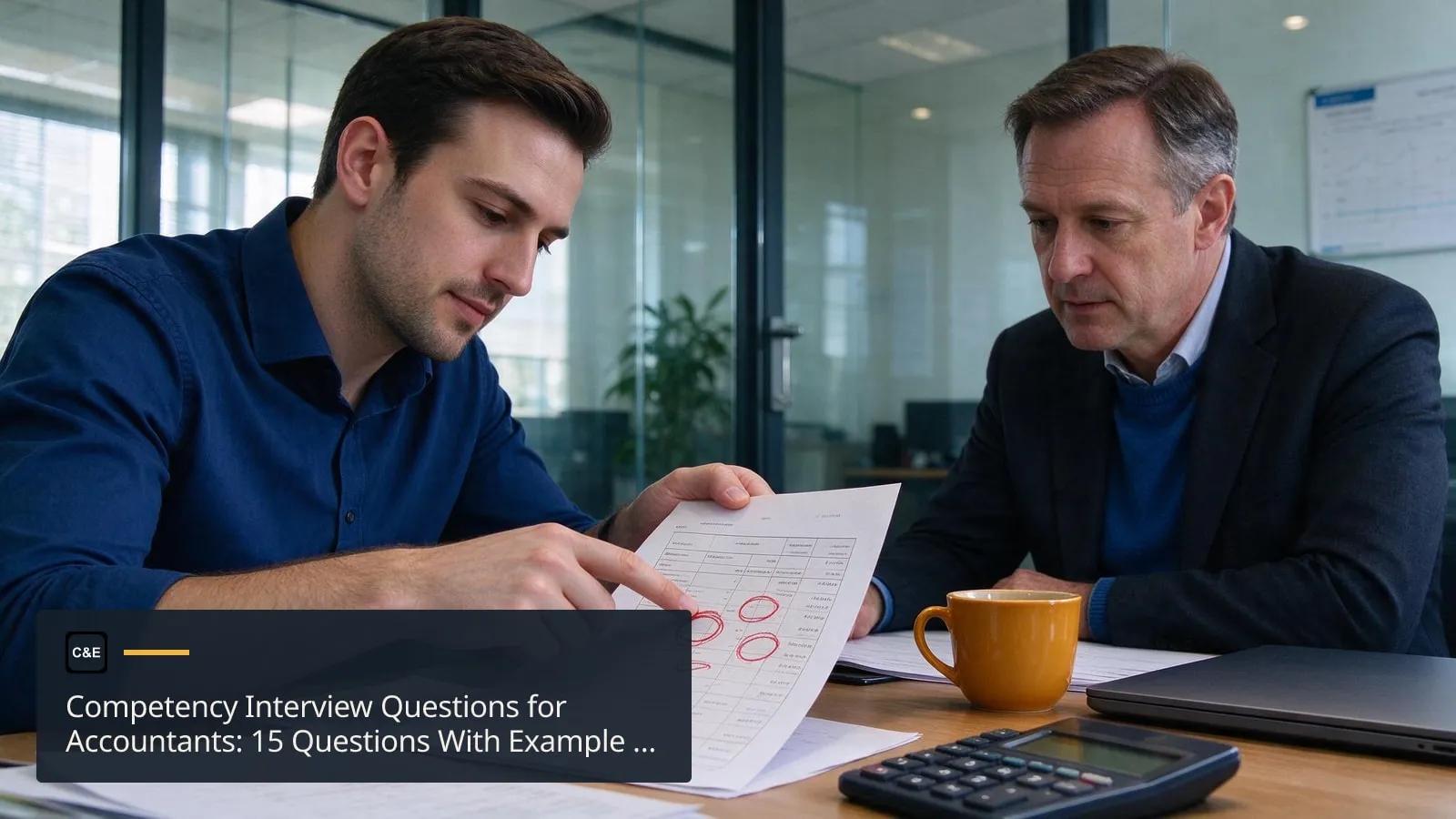
"Tell me about a time you made a mistake" is the competency question accountants dread most, and it's the hardest one to fake. A good answer names a real, modest error you made, shows how you found and fixed it, and ends with the control you added so it couldn't happen again. Below are 15 competency interview questions for accountants, qualified and part-qualified, grouped by what they assess, each with what the interviewer is listening for and an example answer or a plan for building your own.
If you need the STAR method itself, start with our STAR interview examples for finance. This piece assumes you know the structure and want the question bank.
Key takeaways
- Most competency questions for accountants map to one of ICAEW's five fundamental principles, so work out which one the interviewer is testing.
- A strong mistake answer names a real, contained error, shows you owned it quickly and ends with the control you added.
- Prepare at least one genuine mistake story and one integrity story, because interviewers probe those hardest.
- Every story should match a line on your CV and use only figures you could prove if asked.
What competency interview questions for accountants assess
Competency questions test behaviour, not knowledge. Firms publish the behaviours they score. BDO's list, for example, includes "Harnessing Business Thinking", defined as applying "commercial insight, professional judgement and high standards" (BDO early careers). For qualified accountants there's a second, unwritten framework: the profession's ethics code. ICAEW's code sets five fundamental principles: "integrity, objectivity, professional competence and due care, confidentiality, and professional behaviour" (ICAEW Code of Ethics).
Most competency questions for accountants map to one of those five principles. When you prepare an answer, ask yourself which principle the interviewer is really testing.
| Competency | Questions in this bank | Principle it maps to |
|---|---|---|
| Accountability for mistakes | 1–3 | Professional competence and due care |
| Integrity under pressure | 4–6 | Integrity, objectivity, confidentiality |
| Judgement and scepticism | 7–9 | Objectivity |
| Organisation under pressure | 10–12 | Due care |
| Communication and people | 13–15 | Professional behaviour |
The example answers are written by us. They're hypothetical; replace every detail with your own confirmed experience.
Mistakes and accountability (questions 1–3)
1. Tell me about a time you made a mistake.
What it tests: whether you notice your own errors, own them quickly and fix the cause.
Example answer. "In my second year as a management accountant, I posted the monthly payroll accrual using the previous month's headcount file. The P&L for one cost centre looked about right, so I didn't catch it, but the HR business partner queried it after the pack went out. I checked, confirmed the error was mine, and told my manager the same morning with the corrected figure. We reissued that page of the pack. I then changed my close checklist so the accrual tab pulls the headcount file's date into a cell next to the total, and I check that date before posting. It hasn't happened since."
Why it works: the mistake is real but contained; the candidate owned it fast; the fix is a control, not a promise to "be more careful".
2. Tell me about a time you found an error after the numbers had been reported.
What it tests: whether you'll raise an error that makes you, or the team, look bad.
Example answer. "After a quarter-end, I was rolling forward a fixed asset register and noticed a disposal from the previous quarter was still depreciating. It meant the reported depreciation charge was overstated. The amount was small, but the quarter had been signed off. I documented the calculation and took it to the financial controller with a proposal to correct it in the current period and disclose it in the reporting notes. She agreed. I added a step to the disposals process so the register is updated the day the disposal is approved."
3. Tell me about a time you missed a deadline or failed at something.
What it tests: honesty, and whether you learn rather than make excuses.
Build your answer from: a deadline you genuinely missed (an exam sitting, a reporting date, a project milestone), what caused it, what you told people and when, and what you changed. Avoid "I worked too hard". Interviewers have heard it and will ask for a real one.
Integrity under pressure (questions 4–6)
4. Tell me about a time you were asked to do something you weren't comfortable with.
What it tests: integrity and objectivity. Expect some version of it in any regulated role.
Example answer. "At a quarter-end, a budget holder asked me to release an accrual for marketing costs because the campaign 'probably won't happen'. There was a signed order and no cancellation, so I didn't think that was supportable. I asked him for evidence it had been cancelled and explained I couldn't release it without that. When he pushed, I told my manager and set out the facts in an email. The accrual stayed. The campaign ran the following month, and the invoice matched the accrual."
Why it works: it describes a common, believable pressure, a polite refusal based on evidence and an escalation route.
5. Tell me about a time you raised a concern about someone else's work.
What it tests: whether you'll challenge a colleague constructively.
Build your answer from: a reconciliation, a review or a handover where you found a gap in someone else's work. Show that you checked your facts first, raised it privately and focused on the fix, not the person.
6. Tell me about a time you had to keep information confidential.
What it tests: confidentiality. Finance staff see salaries, restructuring plans and deal information early.
Build your answer from: working on a restructuring, a payroll change, a sale process or a budget round before it was announced. Explain what you did to keep it contained (file permissions, what you said when asked) without revealing anything you shouldn't in the interview itself.
Judgement and scepticism (questions 7–9)
7. Tell me about a time you disagreed with a manager or senior colleague.
What it tests: whether you'll back a reasoned view when it's uncomfortable, and accept the decision afterwards.
Example answer. "As an audit senior, I thought the client's provision for slow-moving stock was too low, based on the ageing report. My manager initially felt the client's explanation was enough. I prepared a one-page summary comparing the provision rate to items that hadn't moved in over a year, and asked if we could go through it together. He agreed the point needed more work, and we asked the client for sales data after year end. The client increased the provision. If he'd still disagreed after seeing the evidence, I'd have accepted his call and made sure my analysis was on file."
8. Tell me about a time you made a decision without all the information you wanted.
What it tests: judgement, and whether you state your assumptions.
Build your answer from: a forecast built before a key contract was signed, a cut-off decision on the last day of a close, or a cash call with incomplete bank data. Say what you assumed, how you flagged it, and when you revisited it.
9. Tell me about a time something didn't look right.
What it tests: professional scepticism, the instinct auditors and controllers are hired for.
Build your answer from: an analytical review where a ratio moved without explanation, a supplier with a changed bank account, or an explanation that didn't match the documents. The best answers show you asked for evidence before accepting a reasonable-sounding explanation.
Organisation under pressure (questions 10–12)
10. Tell me about a time you had competing deadlines.
What it tests: prioritisation and communication.
Example answer. "During a year-end, the group reporting pack and the auditors' first request list were due in the same week, and I owned both. I listed every item with its due date and who was waiting for it, then agreed with my manager that the group pack came first because it had a hard deadline. I emailed the audit senior with revised dates for the items I'd moved, two days before the original ones. Both went in on the agreed dates, and the audit team said the early warning helped them plan their fieldwork."
11. Tell me about a time you pushed back on a request.
What it tests: whether you can protect quality and deadlines without being difficult.
Build your answer from: an ad hoc analysis request that arrived during month-end. Show that you asked what decision it was for, offered a quicker version or a later date, and agreed it with the requester.
12. Tell me about a process you improved.
What it tests: initiative and whether you measure results honestly.
Build your answer from: a reconciliation you automated, a checklist you introduced or a report you simplified. Give a result only if you can explain how you measured it. Our list of finance CV achievement examples shows how to describe outcomes without inventing numbers.
Communication and people (questions 13–15)
13. Tell me about a time you had to deliver bad news about the numbers.
What it tests: clarity, timing and whether you bring options as well as problems.
Example answer. "In a quarterly reforecast, I found our largest product line would miss its budgeted margin because of a price increase from a supplier. I told the commercial director before the pack went out, not in the meeting. I showed the impact on one page, explained the driver, and brought two options the buyer and I had looked at: a partial price increase to customers or switching part of the volume to a second supplier. He took the second option to the board with our figures."
14. Tell me about a time you helped a colleague develop.
What it tests: whether you're ready to supervise, which matters for senior and assistant manager roles.
Build your answer from: training a trainee on a reconciliation, reviewing a junior's work, or writing a process note. Show how you checked their understanding and what they could do alone afterwards.
15. Tell me about a time you worked with someone difficult.
What it tests: professional behaviour when relationships are strained.
Example answer. "A budget holder regularly sent cost information late, which delayed my variance commentary. Rather than chasing harder, I asked for twenty minutes to understand his month. It turned out he was waiting on a report from a third party. We agreed I'd use an estimate based on his order book and true it up the following month. His submissions became predictable, and the commentary went out on time."
How to prepare your own 15 answers
You won't be asked all 15. Expect a handful, each with follow-ups such as "what would you do differently?" and "what was your role, specifically?"
- List eight real situations from the last three years of your work.
- Tag each with two or three of the competencies above.
- Make sure you have at least one genuine mistake (question 1) and one integrity story (question 4). These are the two interviewers probe hardest.
- Write each story in under 150 words, then say it aloud in under two minutes.
- Check every figure you'd mention against what you could prove if asked.
The stories should match your CV, because the interviewer will have it open. If a CV line is too vague to support a story, fix the line first with the free CV line checker. Then use interview practice, which writes competency questions for the job you've applied for and rates each typed answer.
The one change that lifts most mistake answers: end with the control you added, not with what you learned. "I now check the file date before posting" is evidence; "I learned to be careful" isn't.
Frequently asked questions
How do you answer 'tell me about a time you made a mistake' in an accounting interview?
Pick a real, modest error you made yourself, such as a wrong accrual or a missed reconciliation item. Say how it was found, that you raised it quickly, how you corrected it, and the control you added so it couldn't recur. End with the control, not a vague lesson, and avoid mistakes that suggest poor ethics.
What are competency based interview questions for accountants?
They ask for a specific time you showed a behaviour: owning a mistake, resisting pressure to change a number, challenging a senior colleague, prioritising deadlines or explaining figures to non-finance managers. Interviewers score your actions and judgement, often against the firm's framework and the profession's ethics principles: integrity, objectivity, competence and due care, confidentiality and professional behaviour.
What mistake should I not mention in an interview?
Avoid anything involving dishonesty, a breach of confidentiality, or a serious error you never fixed or reported. Also avoid fake mistakes such as 'I work too hard'. Choose a genuine error with limited impact that you found or owned quickly, corrected properly and prevented from happening again with a specific control.
How many competency examples should I prepare?
Prepare around eight real situations from the last few years and tag each with two or three competencies. That covers most question banks, because one story can answer several questions if you stress a different part of your actions. Make sure the set includes a mistake, an integrity dilemma and a time you worked under pressure.