Finance Graduate Scheme Interview Questions: What Big Four and Bank Grad Schemes Ask
What PwC, Deloitte, KPMG, EY and Goldman Sachs say about their graduate interview stages, the questions each stage asks, what they test, and model answers written by us.
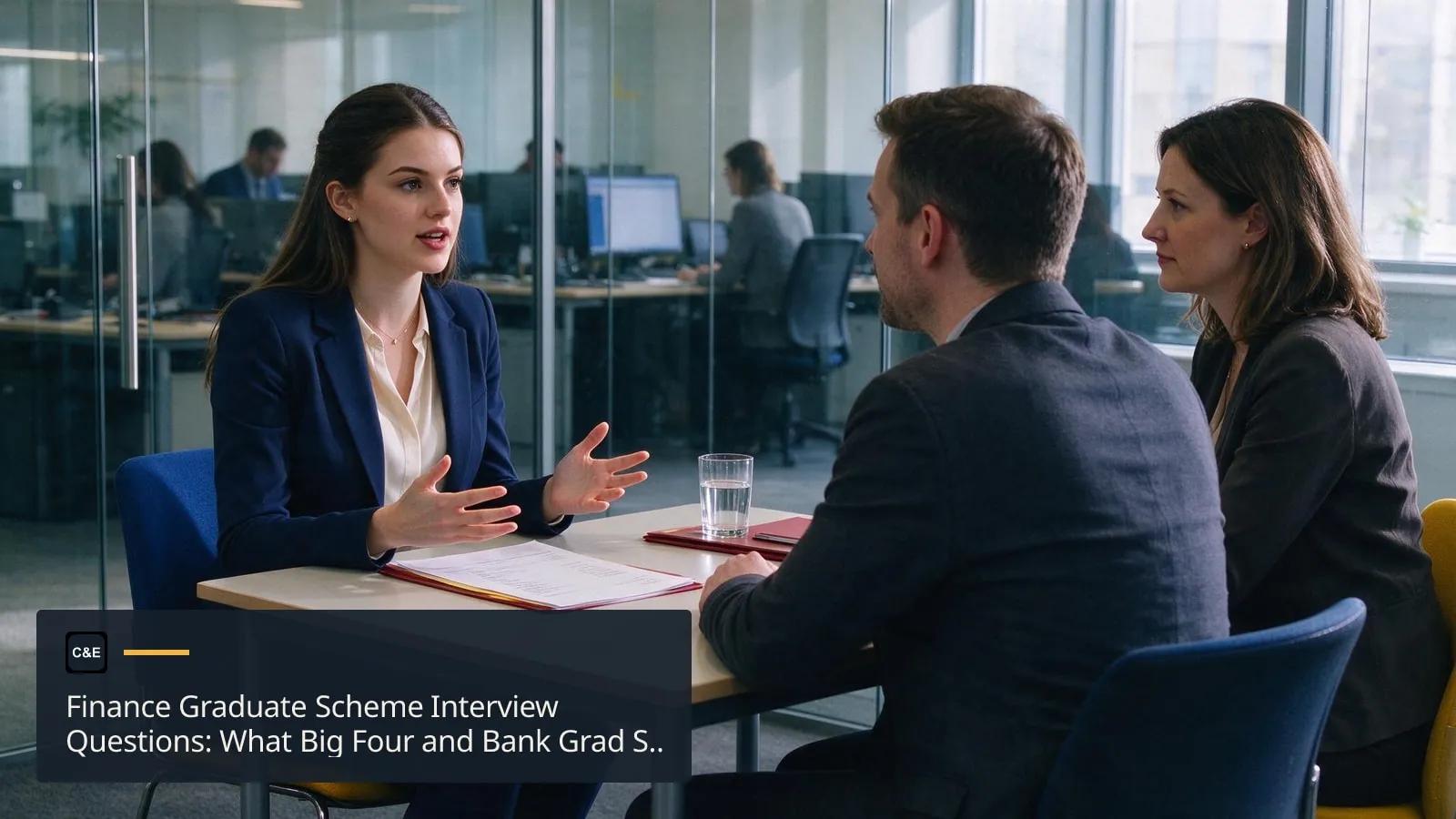
Big Four and bank graduate scheme interview questions fall into four families: why this firm and this programme, what you're good at (strengths), times you've shown a skill (competency), and what's happening in business (commercial awareness). The questions change less than the stage at which they're asked. A recorded video interview asks short, scripted versions; the final interview with a partner or senior leader asks the same things with follow-ups. Below is what each stage looks like at the firms that publish their process, the questions that come up, what each one tests, and model answers written by us.
Key takeaways
- Big Four and bank graduate interviews ask four families of question: motivation, strengths, competency and commercial awareness.
- Most firms put you through online tests and often a recorded video interview before you speak to anyone, and a recruiter or assessor still scores the recording.
- The final stage is almost always a motivation-heavy interview with a partner, senior leader or senior team.
- Firms such as PwC and KPMG check for copied or AI-assisted answers, so use model answers for structure only.
- Start by writing your 'why this programme' answer around one task you have actually done.
How finance graduate schemes interview you, stage by stage
Most of the firms below put you through online tests, and often a recorded interview, before anyone meets you. Volume is the reason. The Institute of Student Employers' 2025 survey found employers received 140 applications per graduate vacancy for the second year running, the highest since it began collecting the data in 1991. Our breakdown of how many applications it takes to get a finance job in the UK puts those numbers in context. Public-sector finance is tighter still: the Civil Service Finance Fast Stream had 4,023 first-preference applications for 36 vacancies in 2026.
Here's what each firm's own careers page says about the stages for its 2026–27 graduate intake.
| Employer (region) | Online tests | Recorded interview | Group or case stage | Final stage |
|---|---|---|---|---|
| PwC (UK) | Behavioural and cognitive tests on SHL | On-demand video interview, reviewed by an assessor | Virtual immersive assessment centre | In-person interview with a senior leader |
| Deloitte (UK) | Behavioural, numerical and verbal | Video answers inside a job simulation | Discussion of a topic you research beforehand | Skills and motivation interview, about 50 minutes |
| KPMG (UK) | Skills assessment plus a 36-minute cognitive test | Six questions asked by an AI avatar, scored by a recruiter | Launch Pad, an in-person half day | Assessed activities on the Launch Pad day |
| EY (UK) | Realistic Job Preview and behavioural skills test | Not listed separately | EY Experience Day | Experience Day |
| EY (Ireland) | Ranking, slider and written questions | Not listed | None listed | Strengths-based interview with the leadership team |
| Deloitte (Ireland) | Online assessment | Not listed | Pre-interview event | One-stage, competency-based interview |
| Goldman Sachs | HackerRank for engineering only | Video interview of about 30 minutes | None listed | Superday of two to five interviews |
Two things follow from that table. First, the recorded interview often comes before you've spoken to a person, so it's easy to under-prepare for it. Second, the final stage is almost always a conversation about motivation with someone senior. Prepare for both from the start.
Graduate scheme interview questions at the video stage
Recorded interviews give you a question on screen, a short time to think and a fixed time to answer. KPMG says its six questions are asked by an AI avatar called Leah, but a member of its student recruitment team reviews and scores the recordings. PwC says the same: answers are "reviewed afterwards by one of our assessors". So you're talking to a person, just later.
Expect short versions of these:
- Why have you applied to this programme? Tests whether you know what the job involves day to day.
- What would you bring to the team? Tests self-awareness. Name one strength and the evidence for it.
- Tell us about a time you had to learn something quickly. Tests learning ability, which matters because trainees sit professional exams while working.
- Describe a time you worked with people who disagreed with you. Tests collaboration.
- What's a business story you've followed recently? Tests commercial curiosity.
Model answer: "Why have you applied to this programme?" (Example answer, written by us. Swap in your own confirmed details.)
"I want to train as a chartered accountant, and audit is the fastest way to see how lots of different businesses actually work. During my placement in a hotel group's finance team, the part I enjoyed most was year-end, when I pulled together the support for the auditors' requests. I liked tracing a balance back to the documents behind it. Your programme combines that work with the ACA, and the office I've applied to audits a lot of hospitality and leisure clients, which is the sector I know best."
Why it works: it names a real task the candidate did, connects it to what auditors do and gives one firm-specific reason. If you're still deciding between qualifications, our ACCA vs CIMA vs ACA comparison explains which route each firm type usually offers.
Strengths and competency questions
Strengths questions ask what you enjoy and do well. Competency questions ask for a time you did something. Firms label their interviews differently (EY Ireland calls its final interview strengths-based; Deloitte Ireland calls its interview competency-based), but you need stories for both.
Strengths questions to prepare:
- What kind of task gives you energy, and which drains you?
- When do you do your best work?
- What do your friends or colleagues come to you for?
- What have you learned recently that you didn't have to learn?
Competency questions to prepare:
- Tell me about a time you met a tight deadline.
- Tell me about a time you noticed something others missed.
- Tell me about a time you changed your approach after feedback.
Model answer: "What do you enjoy doing?" (Example answer, written by us.)
"I enjoy turning a messy pile of information into something people can use. As treasurer of my university's climbing club, I took over a year of receipts kept in a shoebox and a spreadsheet nobody trusted. I rebuilt the records month by month, found two payments that had been entered twice, and set up a shared sheet the committee still uses. The bit I liked was the moment the bank balance finally agreed. I'd want the same feeling from audit work."
Strengths answers still need evidence. The structure for competency answers is in our STAR interview examples for finance, which shows how to build six to eight stories from your CV.
Commercial awareness questions
Graduate interviewers don't expect you to be an analyst. They want to see that you read about business, can explain one story clearly, and can say why it matters to the firm's clients. Good stories for finance applicants are ones that touch the firm's own work.
Common versions:
- What's a business story you've followed recently, and why does it matter?
- What challenges do you think our clients face this year?
- How might AI change the work of a first-year auditor or analyst?
- If you could invest in one company, which and why? (bank schemes)
Model answer: "Tell us about a story you've followed." (Example answer, written by us.)
"I read the Financial Reporting Council's audit quality review in July. Across 116 inspected audits, 79% needed no more than limited improvements, and at the six largest firms the figure was 83%. What struck me was that the regulator inspects specific audits and publishes results by firm, so quality is measured, not claimed. For a trainee, that means the documentation I write on day one is the evidence an inspector might read later. It made me take audit file work more seriously."
The figures are from the FRC's Annual Review of Audit Quality, July 2026. Use a story you've actually read, and check every number you quote. If you're applying for audit, our Big Four audit interview questions with model answers cover the technical side.
Bank graduate scheme questions
Bank interviews add technical and markets questions to the same core. Goldman Sachs says its superday is "typically" two to five interviews depending on the division, with people you might work with. Expect:
- Why banking, and why this division? Tests whether you know what the division does.
- Walk me through your CV. Tests whether you can tell a two-minute story with a direction.
- What's happening in markets? Tests whether you follow one market closely, not every market vaguely.
- How do the three financial statements link? Tests accounting basics.
- Why us and not a Big Four firm? Tests whether you've thought about the trade-off.
Model answer: "Why investment banking rather than audit?" (Example answer, written by us.)
"I've looked at both seriously. I did an audit insight week and enjoyed the rigour, but most of the work looked back at what had already happened. What I want is to work on decisions before they're made: whether a company should buy another, and at what price. In my dissertation I valued a listed retailer and found the part I liked most was arguing about assumptions. Banking puts that argument at the centre of the job."
The final interview with a partner or senior leader
This is where the motivation questions return, with follow-ups. PwC's final stage is an in-person interview with a senior leader from the business area you've been matched to, where you "tell us more about why you are interested in joining PwC". Deloitte's final stage includes a skills and motivation interview that "usually lasts around 50 minutes". Grant Thornton holds its final interview during an in-person experience day with senior people from the service line you applied for.
Questions partners ask:
- Why this firm, and why this office?
- What do you think a first-year trainee does all day?
- How will you manage professional exams alongside client work?
- What would you do if a client was rude or slow to give you information?
- Where do you see yourself after qualifying?
For the motivation questions, our companion piece on "Why audit?" and "Why this firm?" model answers goes through how to build a firm-specific answer from research. For the questions you ask at the end, see our list of 25 questions to ask at the end of a finance interview.
One warning on all of these. Firms are watching for borrowed answers. PwC says it checks for "highly similar responses" and AI-assisted support, and KPMG says it will be "re-testing elements of the online assessments". Use the model answers here for structure, then write your own from your own experience.
A two-week preparation plan
| Days | What to do |
|---|---|
| 1–2 | Read the firm's process page and note each stage and its format |
| 3–4 | Write six to eight stories from your CV and tag each with two competencies |
| 5–6 | Draft your "why this firm" and "why this programme" answers from research |
| 7–8 | Pick two business stories and practise explaining each in 90 seconds |
| 9–10 | Record yourself answering five video questions under time pressure |
| 11–12 | Practise the technical basics for your area (audit, tax or banking) |
| 13–14 | Prepare three questions to ask and rehearse the final interview aloud |
If your CV lines are vague, the stories built on them will be too. Check them first with the free CV line checker, then use interview practice to get questions written for the job you've applied for, with feedback on each answer.
The single most useful thing you can do this week is write your "why this programme" answer around one task you've actually done. Every later stage builds on it.
Frequently asked questions
What questions are asked in a graduate scheme interview?
Expect four types: why this firm and programme, strengths questions about what you enjoy and do well, competency questions asking for a time you showed a skill, and commercial awareness questions about a business story. Bank schemes add technical and markets questions. The same themes come back at every stage, with more follow-up questions in the final interview.
How do I prepare for a Big Four graduate interview?
Read the firm's own description of its stages, then prepare six to eight stories from your CV, a firm-specific answer to 'why this programme', two business stories you can explain in 90 seconds, and three questions to ask. Practise recorded answers under time pressure, because the video interview usually comes before you meet anyone.
Are graduate video interviews marked by AI?
Not at the firms we checked. KPMG uses an AI avatar to ask its six questions, but says a member of its student recruitment team reviews and scores your answers. PwC says its on-demand video answers are reviewed afterwards by an assessor, and that it does not use AI to assess candidate performance in early careers selection.
How long is a Goldman Sachs superday?
Goldman Sachs says it typically conducts between two and five interviews for campus hires at the superday, depending on the division, with people you could work with. Before that, selected applicants complete a video interview of about 30 minutes. Exact timings depend on the division and region, so check your invitation.