Finance Assessment Centre Guide: Group Exercise, Case Study and E-tray, Step by Step
What PwC, Deloitte, KPMG, BDO and Grant Thornton say their assessment centres involve, what assessors score, and a step-by-step method for the group exercise, case study and e-tray, with a worked example.
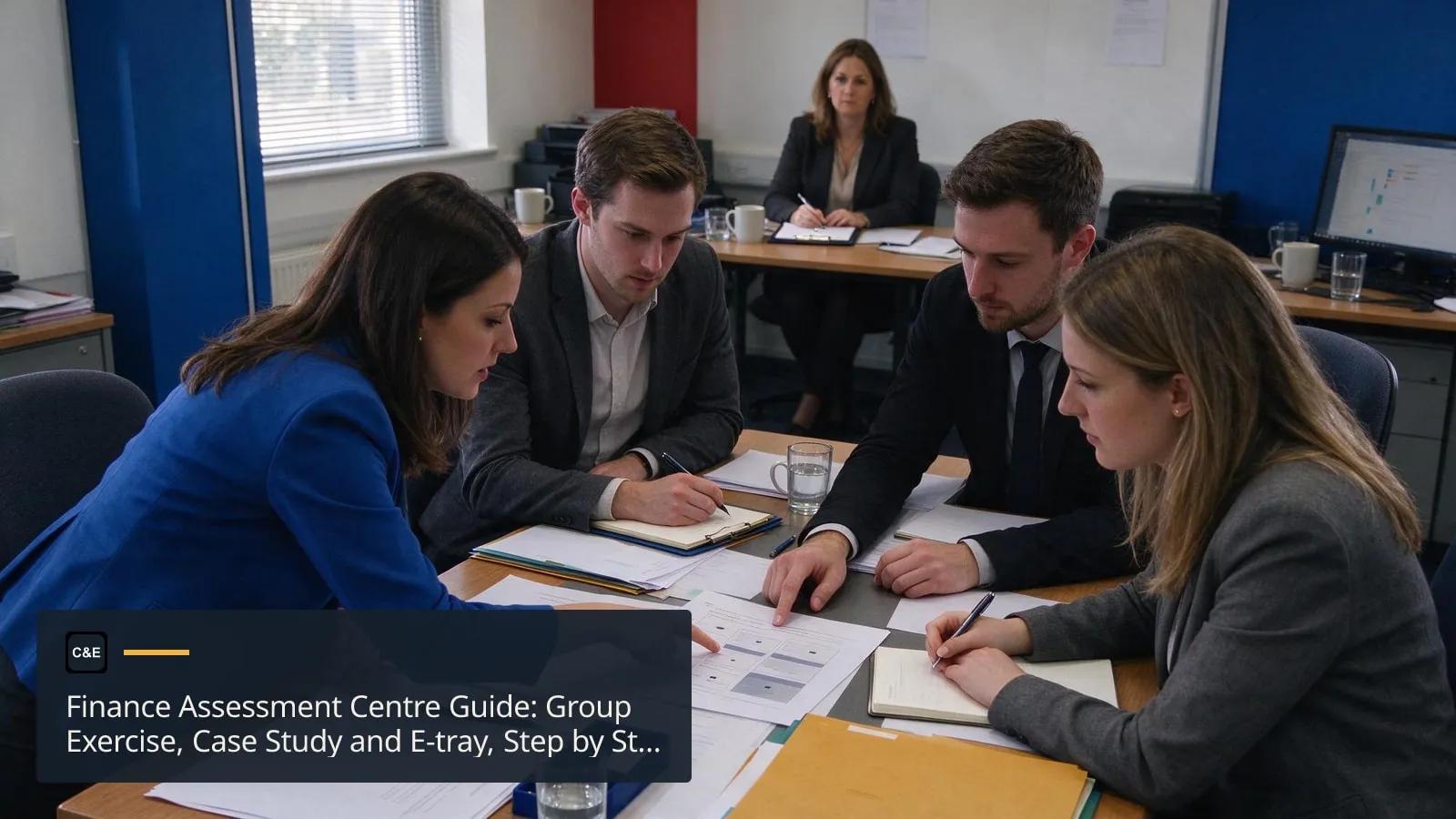
A finance assessment centre is a set of short work simulations, usually a group exercise, a case study you analyse and present, and an interview, scored by assessors against the firm's list of skills. You don't pass by "winning" the group discussion or getting the case "right". You pass by showing the scored behaviours where assessors can see them: structuring a problem, using the numbers, listening, and making a clear recommendation. This guide takes each exercise in turn, shows what assessors are watching for, and works through a sample case study step by step.
Key takeaways
- Finance assessment centres are scored against a published skills framework, so assessors can only reward behaviours they see or hear.
- Most firms we checked now split the assessment into a virtual stage and a shorter final, and none lists an e-tray for its graduate intake.
- In a case study, lead with the recommendation, then the numbers, the cash position, the risks and next steps.
- In the group exercise, restate the question, bring in a figure with each point, include quieter candidates and make sure the group concludes.
- Follow each firm's AI rules exactly: PwC and KPMG forbid outside AI help, while Grant Thornton's written assessment requires a built-in AI tool.
What finance assessment centres look like in 2026
Don't expect one long day of five exercises. Most of the firms below split the assessment into a virtual stage and a shorter final, and none of them describes the old all-day format. Here's what each firm's own careers page says about its graduate intake.
| Firm (UK unless stated) | Format | Exercises named by the firm |
|---|---|---|
| PwC | Virtual immersive assessment centre, then an in-person interview | Assessment against "core skills and attributes"; final interview with a senior leader |
| Deloitte | In person at the office you applied to | A 30–40 minute discussion of a topic you research beforehand; a skills and motivation interview of about 50 minutes |
| KPMG | Launch Pad, an in-person half day | Assessed and non-assessed activities; offer within two working days if successful |
| BDO | Virtual assessment centre, then a face-to-face interview | Case study presentation; group exercise |
| Grant Thornton | Virtual group exercise, then an in-person experience day | Group exercise; final interview with senior people from your service line |
| EY (Ireland) | In person or on MS Teams | Strengths-based interview with the leadership team |
So the three exercises that matter most are the group exercise, the case study (often with a presentation) and the interview. The e-tray, the classic fourth exercise, appears in none of the firm pages above. We cover it at the end because some employers still use one, and Deloitte's job simulation and Grant Thornton's written assessment test similar skills (reading information, prioritising and writing a response) earlier in the process.
What assessors are scoring
Every exercise is scored against a framework. BDO publishes its four: "Leading Self & Others", "Driving Growth", "Harnessing Business Thinking" and "Activating Innovation & Change". PwC assesses "the core skills and attributes that are crucial for success". Grant Thornton says its group exercise looks at how you "collaborate and work as part of a team", including whether you "listen and understand requirements".
Assessors can only score what they see or hear. That's the whole game. Translate each skill into something observable:
| Skill on the framework | What earns marks | What loses marks |
|---|---|---|
| Analysis | Using a figure from the brief to support a point | Opinions with no reference to the data |
| Teamwork | Building on someone's idea by name | Talking over people, or silence for ten minutes |
| Commercial judgement | Linking a recommendation to cash, risk or the client's goal | Recommending what sounds impressive |
| Communication | A clear recommendation first, then reasons | Reading slides aloud |
| Time management | Calling time checks; making sure the group finishes | Running out of time with no conclusion |
The group exercise, step by step
A group exercise gives a small group of candidates a client brief and asks for a joint recommendation against the clock. Here's how to use the time. The timings below assume a 40-minute exercise; scale them to yours.
- Read alone (5 minutes). Note the question you've been asked, the decision-maker, and the two or three numbers that matter most. Don't start talking until you know what the client wants.
- Agree the question and the plan (3 minutes). Say it out loud: "So we need to recommend whether the client should do X, and we've got until 3:40." Suggest an order for the discussion. This is a leadership behaviour, and it's easy to score.
- Work through the options (20 minutes). Bring in a number each time you make a point. When someone quiet hasn't spoken, ask them a direct question: "Priya, you mentioned the cash figure earlier. Does that change your view?"
- Test the leading option (5 minutes). Ask what would make it wrong. In finance, the usual answers are cash, risk, timing and the people involved.
- Agree and summarise (5 minutes). Someone has to say the recommendation aloud. Offer to do it, and credit the people whose points you're using.
- Leave a buffer (2 minutes). Assessors note groups that never reach a conclusion.
Phrases that show the scored behaviours without sounding scripted:
- "Can I check we're answering the same question?"
- "Building on what Sam said about margins, the second option looks weaker because..."
- "We've got ten minutes left. Shall we decide between the two options we've shortlisted?"
- "What would have to be true for this to be the wrong call?"
You don't need to be the loudest person. Grant Thornton's advice for its virtual group exercise is to "listen to others", because it's looking at how you interact, not only how you perform alone.
The case study, with a worked example
Case studies give you a pack (a client email, some financial data, a few pages of background) and ask for a written or spoken recommendation. BDO's version is a presentation where you "analyse information and present your recommendations to assessors". Deloitte asks you to research a topic before the day and discuss it with an assessor for 30 to 40 minutes.
Here's a worked practice case. The business and every figure in it are invented.
The brief. A family-owned builders' merchant with one branch wants to open a second. The owner asks: should we?
The data. Current branch: revenue £4.0m, gross margin 25%, fixed costs £700k a year. New branch: fit-out and stock £600k up front, fixed costs £450k a year, expected revenue £1.5m in year one rising to £2.5m in year three. The business has £400k in cash and an agreed £300k overdraft.
Step 1: answer the question in one line first. "Open the second branch, but only with longer-term funding in place, because year one loses money and the cash is tight."
Step 2: show the numbers that drive it.
| Year 1 | Year 3 | |
|---|---|---|
| New branch revenue | £1.5m | £2.5m |
| Gross profit at 25% | £375k | £625k |
| Fixed costs | £450k | £450k |
| Branch profit or loss | −£75k | £175k |
Break-even revenue is £450k ÷ 25% = £1.8m, so the branch needs to grow about 20% beyond year one to cover its costs.
Step 3: check the cash. The £600k set-up cost would use all £400k of cash and £200k of the overdraft, leaving £100k of headroom before a loss-making first year. The existing branch makes about £300k a year (£1.0m gross profit less £700k fixed costs), which helps, but that cash arrives month by month, not on the day the fit-out bills land. Say so plainly: the profit case works by year three; the cash case is the risk.
Step 4: name the risks and what would change your mind. Slower growth, a margin squeeze if the new branch has to discount to win trade customers, and the owner's time split across two sites. If the client could get a five-year loan for the fit-out, the cash risk mostly goes away.
Step 5: finish with next steps. Ask for the existing branch's monthly cash flow and a trade customer list for the new area before committing.
That structure (answer, numbers, cash, risks, next steps) works for most finance cases, whether the brief is an acquisition, a cost cut or a new product. Our FP&A interview questions guide has more practice on variance and forecasting logic you can reuse here.
The e-tray and in-tray exercise
An e-tray gives you an inbox of emails, memos and attachments and a time limit. Warwick University's careers service describes the core task as prioritising "important and critical tasks" against lower-priority ones, and says candidates are "typically" given one to two hours. Tasks include drafting replies, analysing figures and deciding what to delegate.
For a finance e-tray, triage into three piles:
- Now: anything with a regulatory deadline, a payment cut-off, or a client or partner waiting.
- Today: analysis requests and internal reporting.
- Delegate or park: admin, meeting requests and anything someone else owns.
Write one line of reasoning for each decision. If there's a debrief, the assessor will ask why you put the VAT query ahead of the team lunch booking, and "it had a filing deadline" is a scoreable answer.
The interview and presentation at the assessment centre
The interview is mostly about motivation and evidence, and it can be the longest exercise of the day: Deloitte's skills and motivation interview "usually lasts around 50 minutes", against 30 to 40 minutes for its topic discussion. Prepare six to eight stories using our STAR interview examples for finance, plus firm-specific reasons for applying. Our guide to what Big Four and bank graduate schemes ask at interview covers the questions stage by stage.
For presentations: lead with the recommendation, use no more than three supporting points, and leave time for questions. Assessors often learn more from your answer to "what would change your recommendation?" than from the slides.
Virtual centres and the rules on AI
Virtual centres are scored the same way as in-person ones, so treat the camera as the room. Grant Thornton's advice is blunt: "just because its virtual doesn't mean you shouldn't be professional."
Firms are also policing AI use. PwC says AI tools that "generate, edit, rewrite, summarise, coach or otherwise complete assessment responses" are not permitted unless it explicitly authorises them, and KPMG says candidates found acting dishonestly will be withdrawn. Across employers, the Institute of Student Employers found that using AI during interviews without disclosure or permission was the most common form of misconduct employers reported, cited by 61%.
The exception proves the rule: Grant Thornton's written assessment expects you to use a built-in AI tool, with up to 10 prompts, because it's assessing whether you "know when to rely on AI, when to question its output". Follow each firm's instructions to the letter.
Your checklist for the day before
- Re-read the job description and the firm's skills framework. Our guide to tailoring your CV to a job description shows how to map what an advert asks for to your own evidence; do the same for the framework.
- Practise one case out loud, timed, using the answer-numbers-cash-risks-next-steps structure.
- Write down two questions for the partner or manager you'll meet. Our list of questions to ask at the end of a finance interview has 25 to choose from.
- Check your tech, if virtual: camera, microphone, a quiet room and a charger.
- Prepare two business stories you can explain in 90 seconds.
If you want realistic practice, interview practice writes questions for the role you've applied for and gives you feedback on each typed answer.
The core insight: assessors can only reward what they can observe. In every exercise, say the question, use a number, include the people around you, and finish with a recommendation.
Frequently asked questions
What happens at a finance assessment centre?
Usually a group exercise, a case study you analyse and often present, and an interview, scored against the firm's skills framework. Formats vary: Deloitte's final stage is a topic discussion and a 50-minute interview; BDO's virtual centre is a case presentation and group exercise followed by a face-to-face interview. Check your own invitation for the exact exercises.
How do you pass an assessment centre group exercise?
Assessors score what they observe, so make the scored behaviours visible. Restate the question and agree a plan, support each point with a figure from the brief, invite quieter people in by name, keep time, and make sure the group reaches a recommendation. Being the loudest person isn't the goal; listening and building on others' ideas earns marks.
What is an e-tray exercise?
An e-tray is an online inbox of emails, memos and attachments that you must prioritise and act on against a time limit. Warwick University's careers service says candidates are typically given one to two hours. Tasks include drafting replies, analysing figures and delegating. Sort items into now, today and delegate, and note one reason for each decision.
How do I prepare for an assessment centre case study?
Practise timed cases using one structure: answer first, then the numbers that drive it, the cash position, the main risks and what would change your mind, and next steps. Re-read the firm's skills framework so you can show commercial judgement and clear communication. If the firm sets a topic in advance, as Deloitte does, research it thoroughly.